
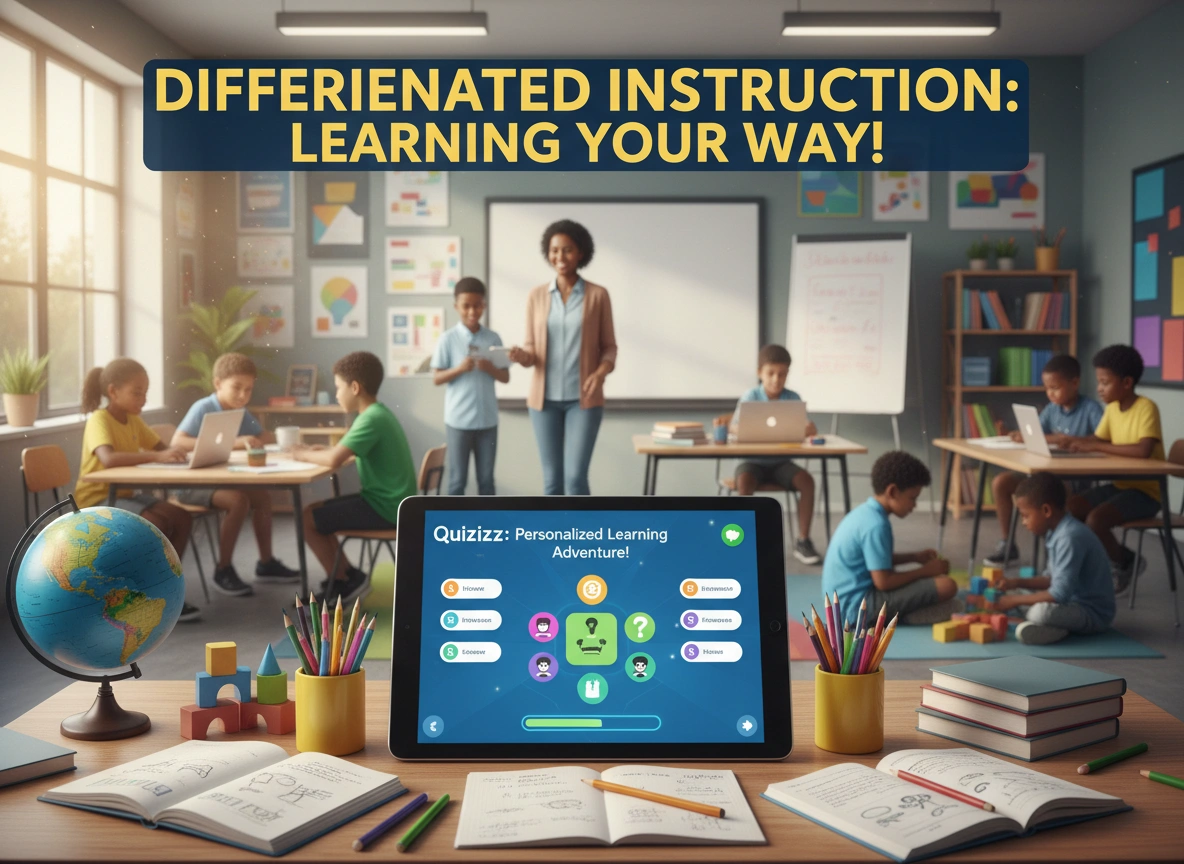

Every classroom is a mix of unique abilities, interests, and learning speeds. One student might grasp algebra instantly but struggle with historical dates, while the student next to them experiences the exact opposite. This reality makes differentiated instruction—the practice of tailoring teaching to meet individual needs—not just a nice-to-have, but an essential component of effective education.
However, differentiation is notoriously difficult to execute manually. Trying to create thirty different lesson plans or quizzes for thirty students is a recipe for teacher burnout. This is where educational technology bridges the gap, and few tools do it as effectively as Quizizz.
This platform has evolved far beyond simple gamified quizzes. It is now a robust ecosystem that supports personalized learning pathways, allowing teachers to meet students exactly where they are. By leveraging customization, real-time data, and flexible pacing, Quizizz transforms differentiation from an overwhelming administrative task into a manageable, engaging part of the daily routine.
The Challenge of the “One-Size-Fits-All” Classroom
Traditional teaching methods often force educators to teach to the middle. If a teacher moves too fast, struggling students get left behind. If they move too slow, advanced students disengage out of boredom. Differentiated instruction solves this by adjusting the content, process, product, or learning environment.
Yet, implementing this strategy requires significant resources. Teachers need tools that can instantly assess understanding, provide immediate feedback, and offer alternative content paths without disrupting the flow of the class. Quizizz addresses these challenges by offering features that inherently support flexibility and individualization.
Customization: Tailoring Content to Learner Needs
The foundation of differentiation is content adjustment. Quizizz allows teachers to modify existing quizzes or create new ones from scratch with remarkable ease. This flexibility means that assessments can be tiered based on student ability levels.
Question Variety and Complexity
Teachers are not limited to simple multiple-choice questions. They can use open-ended questions, polls, fill-in-the-blanks, and draw-on-screen features. This variety supports different learning styles. A visual learner might thrive with image-based questions, while a student who struggles with writing might prefer the drag-and-drop format.
Furthermore, teachers can clone a quiz and create multiple versions of it. One version might include sentence starters or hints for students who need scaffolding, while another version poses more complex, higher-order thinking questions for advanced learners. This allows the entire class to work on the same core topic but at complexity levels appropriate for their current understanding.
Audio and Visual Supports
Accessibility is a major component of differentiation. Quizizz includes a “Read Aloud” feature that benefits students with reading difficulties, dyslexia, or those learning English as a second language. By removing the barrier of reading comprehension from content assessment, teachers can get a truer picture of what a student actually knows about the subject matter.
Self-Paced Learning: Removing the Pressure of the Clock
One of the most stressful aspects of traditional testing is the time constraint. The “Instructor-Paced” mode on Quizizz is excellent for whole-class engagement, but the “Classic” (student-paced) mode is a game-changer for differentiation.
In student-paced mode, questions appear on the student’s own device, and they answer them at their own speed. This seemingly simple feature has profound implications:
- Reduced Anxiety: Students who need more time to process information can take it without feeling the pressure of their peers finishing before them.
- Prevention of Guessing: Without a ticking timer forcing a snap decision, students are more likely to think through their answers rather than clicking randomly to keep up.
- Individual Mastery: Fast finishers aren’t held back. They can complete the assessment and move on to enrichment activities, preventing the behavioral issues that often stem from boredom.
This asynchronous capability extends to homework as well. Teachers can assign quizzes as homework with deadlines that span several days, allowing students to engage with the material when they are most alert and ready to learn.
Real-Time Feedback and Mastery Learning
Feedback is most effective when it is immediate. In a traditional paper-and-pencil setting, a student might not know they misunderstood a concept until days later when the graded paper is returned. By then, the class has moved on.
Quizizz provides instant feedback. As soon as a student answers a question, they know if they were right or wrong. But it goes deeper than a simple checkmark or X.
Redemption Questions and Retakes
The platform gamifies the learning process with “Redemption Questions,” allowing students to re-attempt questions they missed earlier in the quiz. This reinforces the growth mindset—the idea that failure is not final but a step toward mastery.
Teachers can also configure settings to allow multiple attempts at the same quiz. This supports mastery learning, where students are encouraged to review the material and try again until they reach a specific proficiency level. It shifts the focus from “getting a grade” to “learning the content.”
Detailed Explanations
When a student answers incorrectly, Quizizz can display a correct answer explanation (if the teacher has added one). This turns the assessment itself into a learning opportunity. Instead of just seeing that they were wrong, the student immediately learns why, closing the knowledge gap instantly.
Data Analytics: The Engine of Differentiated Instruction
Perhaps the most powerful feature for differentiation is the backend data. Quizizz generates comprehensive reports that do the heavy lifting of analysis for the teacher.
actionable Insights
The reports break down performance by student and by question. A teacher can glance at a report and instantly see:
- Which students are struggling: Identifying students who scored below a certain threshold allows for immediate intervention.
- Which concepts are unclear: If 80% of the class missed Question 5, the teacher knows that specific concept needs to be retaught to the whole group.
- Individual gaps: A teacher can drill down into a specific student’s report to see exactly where misconceptions lie.
This data allows for dynamic grouping. Based on the results of a quick warm-up quiz, a teacher can divide the class into groups for the day’s lesson. Group A (who mastered the concept) moves to independent project work. Group B (who struggled) gathers for a small-group reteaching session with the teacher. This is data-driven differentiation in action.
Practical Classroom Applications
How does this look in a real classroom scenario?
Scenario 1: The Math Review
A math teacher assigns a Quizizz as a warm-up. The data shows that five students have mastered quadratic equations, ten have a basic grasp but made calculation errors, and ten are completely lost.
- Group 1 (Mastery): These students move to an extension activity on Quizizz involving complex word problems.
- Group 2 (Practice): These students work on a similar Quizizz set with “Redemption Questions” turned on to practice and catch their own errors.
- Group 3 (Reteach): The teacher pulls these students aside for direct instruction using physical manipulatives, knowing exactly which part of the equation is confusing them based on the quiz data.
Scenario 2: The Language Arts Station
In a station rotation model, one station is dedicated to Quizizz. Students log in and see quizzes assigned specifically to them.
- ELL students work on vocabulary quizzes with image support and read-aloud enabled.
- Advanced readers analyze a passage with high-level inferential questions.
- The rest of the class works on a grammar check with meme feedback to keep engagement high.
Conclusion
Differentiated instruction is about equity. It is about ensuring every student gets what they need to succeed. While the philosophy is sound, the logistics can be daunting without the right support.
Quizizz provides that support by automating the mechanics of differentiation. Through customizable content, flexible pacing, immediate feedback, and powerful analytics, it frees teachers to do what they do best: connect with students and guide their learning. By integrating Quizizz into the classroom, educators can move away from the “one-size-fits-all” approach and create a dynamic learning environment where every student has the opportunity to thrive.
Please visit website for more info

