
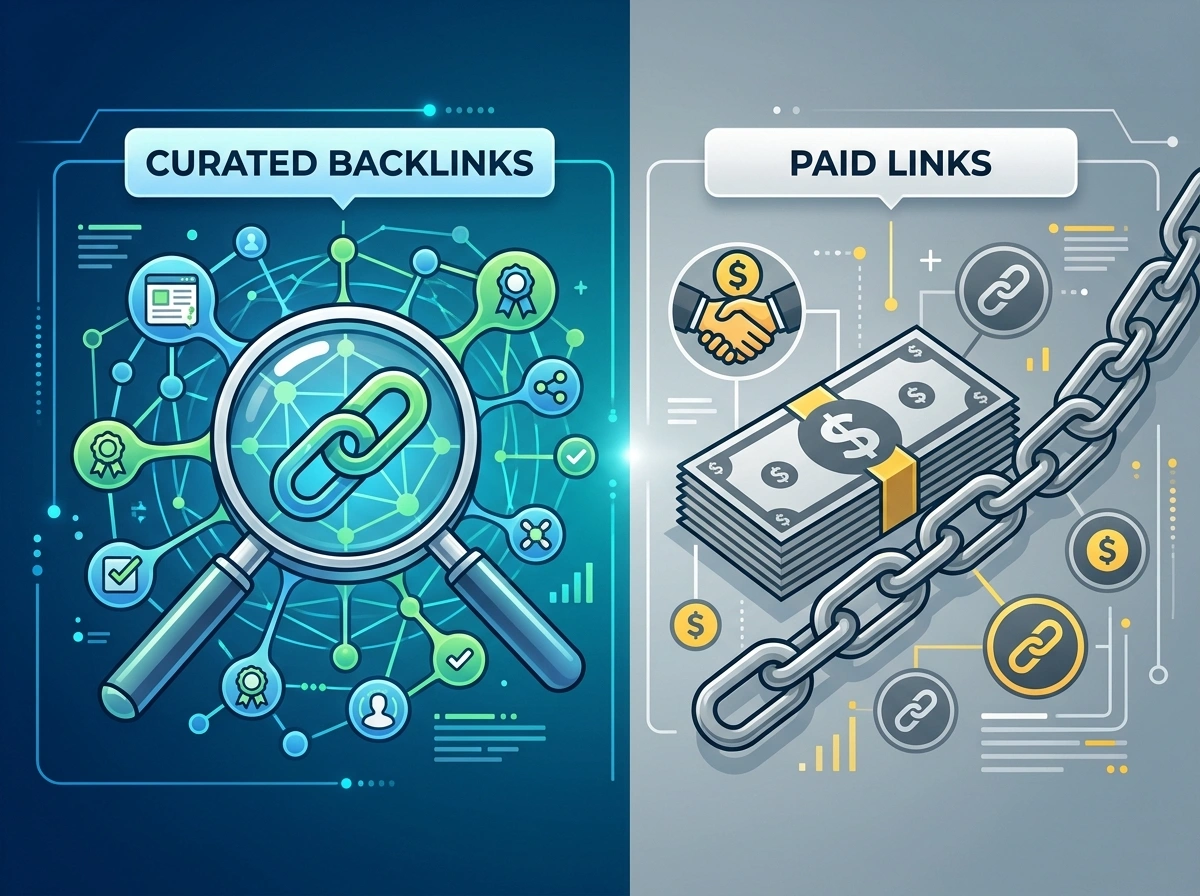

Search engine optimization relies heavily on the quality and quantity of external sites pointing to your pages. Link building remains a cornerstone of establishing domain authority, driving organic traffic, and signaling credibility to search engines like Google. However, not all links are created equal. As site owners look to improve their rankings, they often encounter two distinct methods for acquiring these valuable assets: curated niche edits and direct paid placements.
Navigating the complex landscape of link building requires a clear understanding of the tactics available. Choosing the wrong method can lead to wasted budgets or severe search engine penalties. By learning the distinctions between curated link placements and paid links, you can make informed decisions that protect your website’s long-term health while maximizing your search visibility.
Defining Curated Backlinks (Niche Edits)
Curated backlinks (frequently referred to as niche edits) involve strategically placing a link to your website within an existing, aged article on another domain. Instead of writing entirely new content, outreach teams identify highly relevant, indexed articles that already possess domain authority and organic traffic.
Webmasters are contacted with a proposal to add a contextual link that provides additional value to the reader. Because the content is already established and trusted by search engines, the link equity begins flowing almost immediately. This approach bypasses the “sandbox” period often associated with newly published guest posts. Quality curated links are typically secured on domains with stringent metrics, such as a Domain Authority (DA) of 40 or higher and thousands of monthly organic visitors.
Defining Paid Links
Paid links involve a direct financial transaction between a site owner and a publisher in exchange for a backlink. This can take many forms, including sponsored posts, paid directory submissions, sidebar links, or blatantly purchasing links on private blog networks (PBNs).
While curated outreach requires an investment of time and resources to negotiate editorial placements, paid link schemes usually treat links as direct commodities. The webmaster simply names a price, and the buyer pays it to have their link published, often without regard for strict editorial standards, contextual relevance, or site quality.
Key Differences Between Curated and Paid Links
Understanding how these two strategies differ is critical for executing a safe and effective SEO campaign.
Acquisition Process
Curated placements require manual outreach, relationship building, and strategic negotiation with site editors to prove that your link adds value to their existing content. Paid links are typically transactional. You pay a set fee, and the link goes live, requiring little to no editorial review.
Content Age and Authority
Niche edits are placed in aged posts that search engines have already crawled, indexed, and ranked. This historical authority is a massive advantage. Paid links are often placed in brand-new sponsored articles, sidebars, or footers, which lack established equity and take time to mature.
Search Engine Compliance
White-hat curated placements rely on genuine outreach and editorial integration, aligning closely with providing value to users. Explicitly paying a webmaster for a “do-follow” link to manipulate search rankings directly violates Google’s Spam Policies.
The Pros and Cons of Curated Backlinks
Like any SEO strategy, acquiring niche edits comes with its own set of advantages and challenges.
Benefits
- Faster Indexing and Results: Because the article is already indexed and ranking, the SEO benefits are realized much faster than waiting for new content to gain traction.
- Strong Contextual Relevance: Links are placed directly inside topically relevant text, sending strong authority signals to search engines.
- High Success Rates: When utilizing professional outreach teams, placements can be secured on premium domains that rigorously filter out spam.
Risks
- Resource Intensive: Identifying link gaps, scraping the web for aged articles, and conducting manual outreach takes significant time and specialized software.
- No Control Over the Host Page: The webmaster can later update, delete, or modify the article, which may result in a lost link.
The Risks and Benefits of Paid Links
While highly discouraged by SEO professionals, paid links remain a topic of discussion due to their accessibility.
Benefits
- Speed of Acquisition: Buying a link is fast. There is no need for prolonged negotiation or complex content creation.
- Guaranteed Placement: Since it is a straightforward financial transaction, you know exactly when and where your link will appear.
Risks
- Severe Penalties: Search algorithms are incredibly sophisticated at detecting unnatural link patterns. Buying links can result in algorithmic devaluation or manual actions that completely remove a site from search results.
- Poor Quality Domains: Sites that openly sell links often become link farms. Their outgoing link profiles become bloated, diluting any potential SEO value and increasing toxic risk.
SEO Impact and Search Engine Guidelines
Search engines evaluate links as votes of confidence. When a high-authority, relevant site links to your content, it signals that your page is trustworthy. Curated placements aim to earn these votes through merit and relevance. By integrating naturally into valuable content, they support long-term, sustainable growth in search rankings.
Conversely, search engine guidelines explicitly state that buying or selling links that pass PageRank is a violation of their policies. If Google’s spam team determines a site is participating in link schemes, the offending pages will lose their rankings. Sustainable SEO prioritizes strategies that mimic organic link growth, which is why manual outreach for contextual placements is heavily favored by search marketing leaders.
How to Choose the Right Strategy for Your Site
Selecting the best path forward depends on your risk tolerance, budget, and long-term goals.
Assess Your Foundation
Before engaging in any link acquisition, conduct a comprehensive audit of your current backlink profile. Identify link gaps and analyze your competitor’s strategies. Ensure your site’s technical SEO and on-page content are fully optimized.
Prioritize Quality Over Quantity
It is better to secure a handful of highly relevant, vetted links than hundreds of low-quality placements. Focus on metrics that matter, such as minimum organic traffic thresholds and strict DA requirements. Avoid sites that openly advertise link selling.
Partner with Transparent Providers
If you choose to outsource your link building, look for agencies that offer real-time tracking dashboards and comprehensive reporting. Transparency regarding exact URLs, anchor texts, and the outreach process is essential to guarantee you are receiving safe, white-hat placements.
Next Steps for Your Link Building Strategy
Building a robust backlink profile is not a passive endeavor. It requires strategic planning, ongoing monitoring, and a commitment to quality. While the allure of quick results from paid links can be tempting, the risks far outweigh the short-term benefits.
Focusing your efforts on securing high-quality, contextual placements in established content offers a safer, more effective route to rapid SEO growth. By prioritizing relevance and domain authority, you can build a resilient search presence that withstands algorithm updates and drives meaningful, long-term traffic to your business.

